Disclosure: As an Amazon Associate, AirDaddy earns from qualifying purchases. This helps support our site at no extra cost to you.
Here's something most people don't know: your sealed bedroom routinely hits 2,000–3,000 ppm CO2 by morning — five to seven times the outdoor level. At those levels, Harvard research shows measurable drops in cognitive function, decision-making, and sleep quality.
A CO2 monitor reveals exactly when your bedroom air becomes stale and tells you precisely how much ventilation you need. It's one of the cheapest, highest-impact health investments you can make — especially if you wake up groggy despite 'enough' sleep.
Our Top Picks
Key Factors to Consider
Why CO2 Levels Matter More Than You Think
Outdoor CO2 is roughly 420 ppm. Above 1,000 ppm, concentration and cognitive function drop measurably. Above 1,500 ppm, you'll notice drowsiness and headaches. Bedrooms with doors closed and no ventilation routinely hit 2,000–3,000 ppm by morning — the equivalent of breathing in a poorly ventilated meeting room all night.
NDIR vs eCO2: Don't Get Fooled
Real CO2 monitors use NDIR (non-dispersive infrared) sensors that directly measure CO2 molecules. Cheaper monitors estimate CO2 from VOC readings (eCO2) — these are wildly inaccurate and shouldn't be trusted. For reliable bedroom data, insist on NDIR technology. The Airthings View Plus uses a true NDIR sensor.
Your Bedroom Is the Most Important Room to Monitor
You spend 7–8 hours breathing bedroom air. With doors closed and limited ventilation, CO2 from breathing accumulates rapidly. Two adults can push a 15m² bedroom above 3,000 ppm within hours. A CO2 monitor reveals exactly when levels become problematic.
The Fix Is Usually Simple
A 2cm window gap or trickle vent is often enough to keep CO2 below 1,000 ppm. The monitor tells you the minimum ventilation needed — so you can balance fresh air with keeping warm in winter. No expensive equipment required.
Our Recommendations
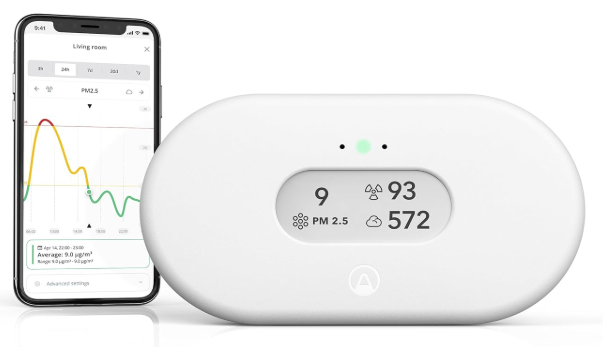
Airthings View Plus
Typical price: ~£250True NDIR CO2 sensor with excellent accuracy. The app logs CO2 levels overnight, showing exactly when your bedroom air quality deteriorates and how different ventilation strategies affect levels. Invaluable data for optimising sleep.
- ✓ True NDIR CO2 sensor — accurate readings
- ✓ Overnight CO2 tracking reveals sleep-affecting patterns
- ✓ Also monitors PM2.5, VOCs, humidity, and radon
- ✓ Battery-powered — place anywhere
- ✗ Premium price
- ✗ App required for historical data
- ✗ No audible CO2 alerts
⚠️Prices can change frequently on Amazon.
💡Air purifiers only work properly if filters are replaced regularly. See our Filter Club for guidance.
Comparison Table
| Product | Best For | Price | Rating | CO2 Sensor | Other Metrics |
|---|---|---|---|---|---|
| Airthings View Plus | Best Overall CO2 Monitor | Typical price: ~£250 | 4.8 | N/A | Whole home |
Pros & Cons
Pros
- ✓ Reveals hidden ventilation problems affecting your sleep quality
- ✓ Directly linked to measurable improvements in cognitive function
- ✓ Helps you ventilate efficiently — only open windows when data says to
- ✓ NDIR sensors provide accurate, reliable CO2 readings
- ✓ The fix (better ventilation) is usually free
Cons
- ✗ Accurate NDIR monitors aren't cheap
- ✗ eCO2 monitors (cheaper alternatives) are misleading
- ✗ A monitor alone doesn't fix the problem — you need to act on the data
- ✗ Some monitors require app subscriptions for full features
Frequently Asked Questions
Conclusion
A CO2 monitor is one of the most impactful air quality investments you can make — particularly for bedrooms. The Airthings View Plus provides accurate NDIR CO2 tracking alongside a comprehensive suite of additional sensors.
If you wake up groggy, have morning headaches, or just feel 'off' despite sleeping enough, your bedroom CO2 is almost certainly too high. A monitor costs £250; better sleep and sharper mornings are priceless. For particle-related air quality, pair it with a bedroom air purifier.
Don't Forget Your Filters
Air purifiers only work if the filters are replaced regularly. Most people forget — and end up breathing dirty air.
Join the Filter Club