Transport has shown greater variability
Early labelled transport periods recorded higher PM2.5 and CO₂ than our labelled home periods. More repeated journeys are needed before drawing broader conclusions.
Explore early findingsIndependent real-world air-quality research for UK homes and everyday environments.
Structured studies and repeatable purifier testing are now being developed.
Real-world monitoring active
Illustrative imagery. Not a photograph of AirDaddy Labs testing.
Disclosure: As an Amazon Associate, AirDaddy earns from qualifying purchases. Affiliate relationships never influence AirDaddy Labs test results or scoring.
Exploratory dataset
These are real AirDaddy measurements, but they are not representative UK population averages.
Early evidence
Three cautious signals from the latest exploratory dataset. Each is labelled by the strength of the evidence behind it.
Early labelled transport periods recorded higher PM2.5 and CO₂ than our labelled home periods. More repeated journeys are needed before drawing broader conclusions.
Explore early findingsOne home period showed falling CO₂ and TVOC alongside rising PM2.5. Window state was not recorded, so this remains a hypothesis rather than a confirmed finding. The readings behind it are on the measurement timeline.
See the readings on the timelineOur highest PM2.5 reading could not be confidently attributed because the environment was not sufficiently annotated. Future monitoring is being more carefully labelled.
Read the methodologyGo deeper
Start with the view that best matches what you want to understand.
Research programme
Active monitoring, early observations and carefully labelled study plans in one place.
Exploratory monitoring across homes, outdoor environments, transport and everyday indoor spaces.
Explore dataRepeated journeys are being collected to understand variation across stations, trains and travel conditions.
View early observationsA home study comparing window-open, window-closed, purifier-on and purifier-off conditions. First window-open observations appear in our Eleva 300X bedroom test.
View study planAirDaddy is developing a repeatable real-home benchmark for comparing purifier performance under the same conditions.
Testing methodologyOur preliminary real-bedroom observations: overnight PM2.5 and CO₂ findings from a UK bedroom. Review sample supplied free by Levoit / VeSync.
Read the bedroom testWhat's next at AirDaddy Labs?
Research exploration
Our first bedroom purifier test highlighted an important question: what happens when airborne particles are low, but indoor CO₂ starts to rise?
AirDaddy Labs is exploring practical ways to monitor indoor CO₂ and improve household ventilation, with a focus on comfortable sleep, fresh-air circulation and smarter home environments. We'll share our research and findings as testing develops.
No CO₂-management product has been developed or independently validated by AirDaddy Labs at this stage.
Understand filtration and ventilationIn use
The monitor behind AirDaddy's published exploratory dataset.
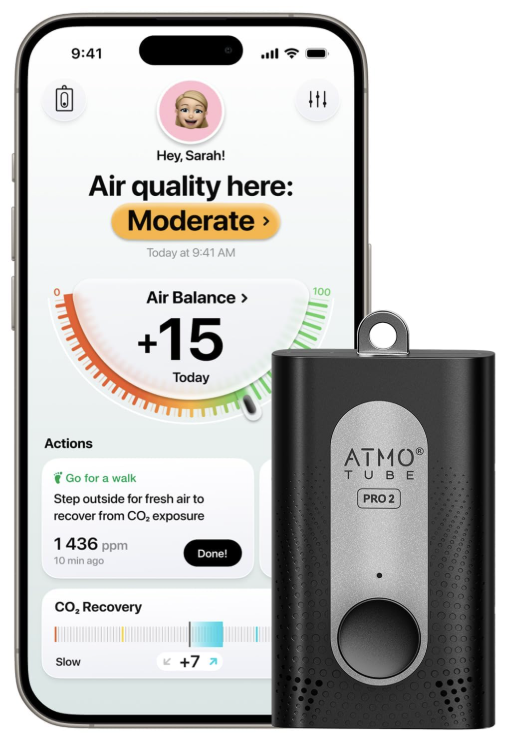
First deployed: August 2026
Metrics measured
PM1, PM2.5, PM10, CO₂, TVOC, NOx, temperature, humidity, pressure and GPS-tagged observations.
Method
A concise framework for collecting, checking and publishing useful evidence.
Real-world observations in UK environments.
Structured tests repeated under consistent conditions.
Methods, findings and limitations shown transparently.
Trust & transparency
AirDaddy Labs separates measurements from interpretation and states what the evidence cannot yet show.
Manufacturers do not determine results or rankings.
Methods, limitations and funding or equipment sourcing are disclosed.
Private residential coordinates are never publicly exposed.
AirDaddy Labs currently publishes exploratory measurements from its own Atmotube PRO 2 monitoring. Precise residential GPS coordinates are never published, and limitations are stated alongside findings.
Real-world monitoring is active. Explore the latest measurements, study plans and methods behind the work.