Putting an Air Purifier to the Test in a Real Bedroom
Independent real-world testing of the Levoit Eleva 300X · September–October 2026
Disclosure: As an Amazon Associate, AirDaddy earns from qualifying purchases. Affiliate relationships never influence AirDaddy Labs test results or scoring.
The question
Can an air purifier really make a difference while you sleep?
Air purifiers promise cleaner air, fewer airborne particles and a healthier-feeling home. But how much difference do they make in an ordinary bedroom, with windows opening and closing, people moving between rooms and the occasional unexpected pollution spike? At AirDaddy Labs, we wanted to find out.
Rather than relying on manufacturer claims or the purifier's own air-quality display, we monitored air quality independently on recorded dates across September and October, testing different fan speeds, ventilation arrangements and everyday household conditions. And because this is a real home, our testing also included the occasional feline quality-control inspection.
Usability
First impressions: design, features and everyday usability
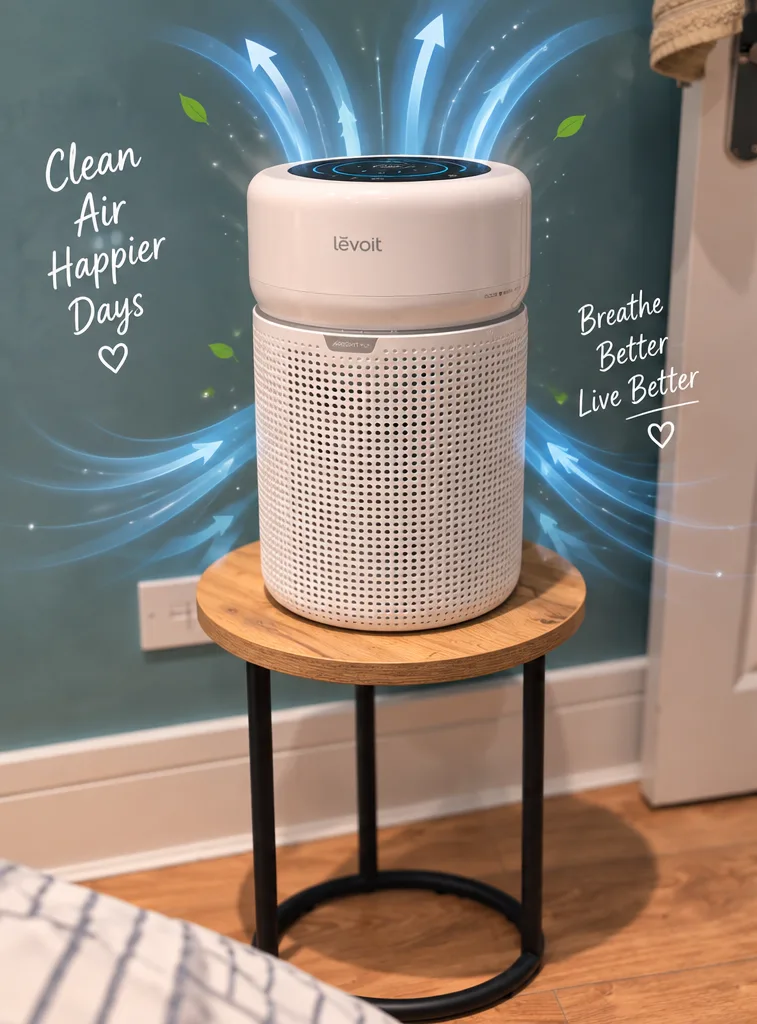
The purifier has a built-in air-quality monitor with a display on top of the unit, so you can check the air quality around the machine. It offers Low, Medium, High, Turbo and Auto modes. Auto is particularly appealing for everyday use because the purifier adjusts itself according to its own sensor.
In our experience Turbo was noticeably loud — although we still slept through an entire night with it running. That won't necessarily be the case for lighter sleepers.
Method
How we tested it
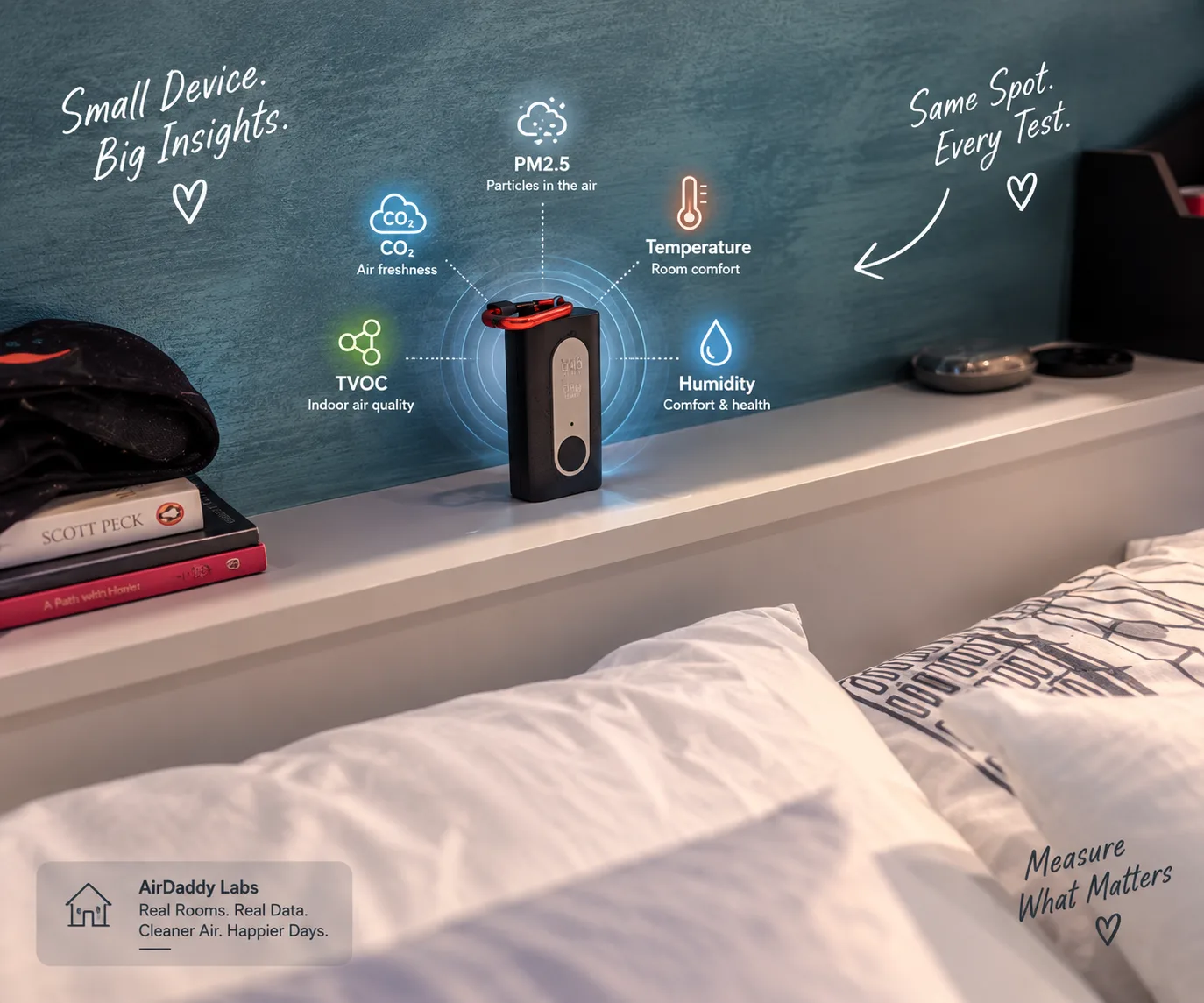
Testing took place in a regularly occupied bedroom between September and October 2026. We used a separate Atmotube PRO 2 air-quality monitor, positioned on the bedstead above the sleeping occupant's head.
This was deliberate. The purifier's own sensor sits close to the machine and may not represent conditions elsewhere in the room, so an independent monitor away from the purifier shows the air the sleeper actually breathes.
We monitored:
- PM1, PM2.5 and PM10 airborne particles
- Carbon dioxide (CO₂)
- Total volatile organic compounds (TVOC)
- Temperature and relative humidity
- Changes associated with ventilation and purifier settings
We also kept notes on window positions, fan operation, purifier modes, sleep times and unusual events. These were real-world observational tests, not laboratory-certified CADR or filtration-efficiency measurements. See our testing methodology.
Sleep-period averages run from the owner's labelled sleep-start time up to, but excluding, the wake-up or configuration-change reading. They are arithmetic means of nonblank readings, with zeros retained and no interpolation. Times below are local Europe/London times; the September and early October intervals were in British Summer Time. Where sleep onset was not separately labelled, we report a mode-operation interval, not a verified sleep-period average.
Results
Test results: what did we discover?
1. Several test nights had very low particle readings
During our first closed-window Medium sleep window, 22 September 22:07 to 23 September 05:54, average PM2.5 was 0.52 µg/m³ (34 samples). The Low repeat, 7 October 22:32 to 8 October 05:49, averaged 0.64 µg/m³ (29 samples). The preceding OFF control, 6 October 22:39 to 7 October 05:37, averaged 1.71 µg/m³ (29 samples) — approximately 63% lower measured average PM2.5 on the Low night.
These were different nights and background conditions may have varied, so the difference should not be read as certified purifier effectiveness, a controlled causal effect or a CADR measurement. The percentage uses unrounded means, not the rounded values displayed above.
2. More fan power didn't always mean lower readings
Later PM2.5 means are shown below. Only Medium has a separately labelled sleep-start time.
| Setting and interval | Mean PM2.5 | Samples |
|---|---|---|
| Medium · labelled sleep 8 Oct 22:49–9 Oct 06:04 | 0.47 µg/m³ | 29 |
| High · mode-operation interval 9 Oct 23:13–10 Oct 07:43 | 0.72 µg/m³ | 35 |
| Turbo · mode-operation interval 10 Oct 22:05–11 Oct 06:12 | 1.03 µg/m³ | 35 |
That may look surprising, but the starting air quality and the room's fan arrangement differed between nights, and at such low concentrations measurement uncertainty matters. We therefore can't conclude that Medium is more effective than High or Turbo.
The full High-mode interval includes a separate room fan being switched off at 23:46; that was not a purifier-speed change. Neither High nor Turbo has a separately labelled sleep onset. The tester's experience of sleeping through Turbo is subjective testimony, not a sensor-verified sleep interval.
3. CO₂ was lower on the window-open night
With the window closed on Medium, the labelled sleep window on 22 September 22:07–23 September 05:54 averaged 1,175 ppm (467 samples). With the window open around 10 cm and Medium still running, 23 September 21:53–24 September 05:36 averaged 728 ppm (463 samples) — approximately 38% lower average measured CO₂ between observational test nights, calculated from unrounded means. This is not a controlled causal effect. That's consistent with extra ventilation: particle air purifiers don't meaningfully remove exhaled CO₂.
Why the air purifier didn't solve our bedroom CO₂ problem
One of the most interesting discoveries wasn't about particles. It was about ventilation. These observations were conducted on different nights, so the comparison doesn't establish a precisely controlled ventilation effect. It does illustrate an important distinction: conventional air purifiers filter airborne particles, but they do not meaningfully remove the CO₂ people breathe out. That isn't a purifier malfunction — filtration and fresh-air exchange solve different problems.
A circulating room fan moves air around but does not, by itself, guarantee fresh-air exchange. Opening a window can improve ventilation, although its effectiveness depends on outdoor air, airflow, occupancy and the wider property. Our air purifier versus open window guide explains how these approaches differ.
Our takeaway: low particulate readings don't automatically mean a bedroom is adequately ventilated. Air purification and fresh-air exchange solve different problems. A CO₂ monitor can help you observe changes, but monitoring does not itself ventilate a room or remove CO₂. Understanding both can help you make better indoor air-quality decisions.
4. Whole-export readings during everyday use
Across the whole 14–29 October monitor export, median PM2.5 was 1.4 µg/m³ (1,404 nonblank readings) and median CO₂ 695 ppm (20,867 readings). The export ends at 08:44 on 29 October, includes measurements outside the bedroom and gaps, and has 19,463 blank PM2.5 rows. Notes record both OFF and Auto operation; continuous Auto operation is unverified. These are whole-export descriptions, not bedroom-only results or a measure of Auto-mode performance.
We also caught occasional large spikes, including a verified sensor PM2.5 reading of 404.4 µg/m³ on 25 October. Its source, room location and purifier response are unknown. Events like this show why long-term monitoring is useful: a room can change a lot even when everyday readings look reassuring.
5. Noise and overnight comfort
Low and Medium were practical for overnight use. Turbo was much louder, though the tester still slept through a full night. We haven't measured sound levels in decibels, so this assessment is subjective.
Summary
What we liked, and what could be better
What we liked
- Multiple operating modes for different situations
- Convenient built-in air-quality display
- Auto mode for everyday operation
- Very low measured particle levels on several test nights
- Runs continuously overnight
What could be better
- Turbo is noticeably loud
- The built-in display reads the air next to the purifier, not necessarily the whole room
- It doesn't replace ventilation for managing CO₂
Honesty
Limitations of our testing
Our results come from a lived-in bedroom, not a controlled chamber. Pollution sources, outdoor conditions, ventilation, occupancy and a separate room fan weren't identical every night. Particle readings were mostly logged about every 15 minutes, which limits how precisely we can measure how fast pollution clears. We did not measure clean-air delivery rate, filter efficiency, power use or sound output.
The exports are not uninterrupted bedroom monitoring: there are sampling gaps, monitor-away periods and no supplied readings between 25 September and 4 October. A repeated Low night is not proof of consistent performance across every Low night; earlier September Low observations differed. We do not interpolate gaps or infer bedroom location or purifier operation where the notes do not establish them.
Product identity: the tested unit is sold in the UK as the Levoit Eleva 300X, and the unit's historical packaging identifies it as the Eleva 300X. Earlier AirDaddy working documents referred to the test unit as the "Salute 300"; that name is retained in our underlying testing provenance. The environmental readings themselves do not independently identify the purifier model.
Verdict
Our preliminary verdict
The Levoit Eleva 300X delivered encouraging results in real bedroom use, with consistently low particle readings across several modes. Medium seemed a practical balance between everyday comfort and measured air quality. Auto was convenient in the tester's experience, but the wider export cannot establish continuous Auto operation or bedroom-only Auto performance.
The strongest lesson, though, is that clean air needs both filtration and ventilation. A purifier helps with airborne particles, but opening a window or otherwise letting in fresh air remains important for CO₂. For more on sleeping air, see our bedroom testing protocol.
Final rating: pending our operating-cost assessment and final evidence review.
AirDaddy Labs independently monitored this product in a real home. These observations are not certified laboratory testing.
Price check
Where to buy the Levoit Eleva 300X
The Eleva 300X is sold in the UK through Amazon. We don't set or control retail prices, and the current price is shown on the retailer's listing.
This is a sponsored affiliate link. As an Amazon Associate and VeSync / PartnerBoost partner, AirDaddy earns from qualifying purchases, at no extra cost to you. Affiliate partnerships never influence our test results, findings or conclusions.
Questions and answers
Did the Levoit Eleva 300X lower PM2.5 in a real bedroom?
In our labelled Low-speed sleep window, average PM2.5 was 0.64 µg/m³ (29 samples), against 1.71 µg/m³ (29 samples) on the preceding purifier-off night — approximately 63% lower measured average between separate nights. This is not certified purifier effectiveness, a controlled causal effect or a CADR measurement.
Does an air purifier reduce CO₂ in a bedroom?
No. The closed-window Medium sleep window averaged 1,175 ppm (467 samples), while the separate night with the window open about 10 cm averaged 728 ppm (463 samples) — approximately 38% lower average measured CO₂. These are observational nights, not a controlled causal comparison. Particle purifiers do not meaningfully remove exhaled CO₂ — ventilation does.