Disclosure: As an Amazon Associate, AirDaddy earns from qualifying purchases. This helps support our site at no extra cost to you.
PM2.5 is the single most dangerous thing in your indoor air — and you can't see it, smell it, or feel it. These microscopic particles (30x smaller than a human hair) bypass your body's defences, penetrate deep into your lungs, and enter your bloodstream. Long-term exposure is linked to heart disease, lung cancer, and shortened life expectancy.
The scariest part? Your kitchen produces more PM2.5 than a busy road. A single frying session can spike indoor levels above 200 µg/m³ — more than 40x the WHO's recommended safe limit. A PM2.5 monitor is the only way to know what you're actually breathing.
Our Top Picks
Key Factors to Consider
What PM2.5 Actually Is
PM2.5 stands for Particulate Matter under 2.5 microns — tiny fragments of combustion byproducts, dust, pollen debris, mould spores, bacteria, and chemical aerosols. They're dangerous because they're small enough to reach the deepest part of your lungs (the alveoli) where gas exchange happens, and from there, enter your bloodstream.
Your Kitchen Is the Biggest Threat
Cooking — especially frying, grilling, and toasting — is the largest indoor PM2.5 source. A single cooking session can spike levels above 100–300 µg/m³. Candles and incense are also significant sources. Without a monitor, you'd never know your bedroom candle is creating pollution worse than a busy London street.
What Levels Are Healthy?
The WHO recommends annual average PM2.5 below 5 µg/m³ and 24-hour averages below 15 µg/m³. Most well-ventilated UK homes sit between 5–15 µg/m³ at baseline. During cooking or candle use, spikes to 50–200+ µg/m³ are common. A real-time monitor reveals these invisible surges.
How PM2.5 Monitors Work
Consumer monitors use laser scattering: air is drawn through a chamber where a laser beam hits particles. The scattered light pattern tells the sensor particle count and size. Better monitors use higher-quality lasers for improved accuracy — particularly at low concentrations where precision matters most for health.
Our Recommendations
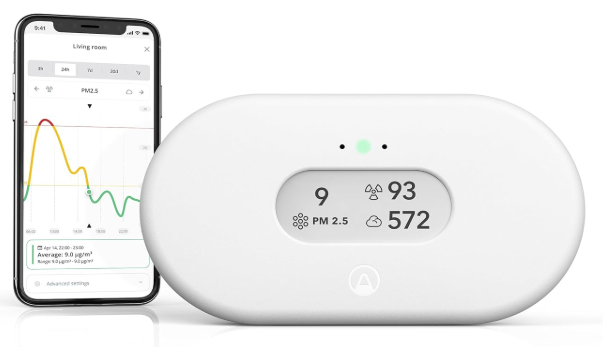
Airthings View Plus
Typical price: ~£250Tracks PM2.5 alongside CO2, VOCs, humidity, temperature, pressure, and radon. The app logs trends over weeks and months — revealing cooking spikes, overnight patterns, and seasonal changes you'd never notice otherwise.
- ✓ Accurate laser-based PM2.5 sensor
- ✓ Historical trend data reveals hidden patterns
- ✓ 7 total air quality metrics
- ✓ Battery-powered — place anywhere
- ✗ Premium price
- ✗ PM2.5 sensor updates less frequently than dedicated monitors
- ✗ App required for full data access
⚠️Prices can change frequently on Amazon.
💡Air purifiers only work properly if filters are replaced regularly. See our Filter Club for guidance.
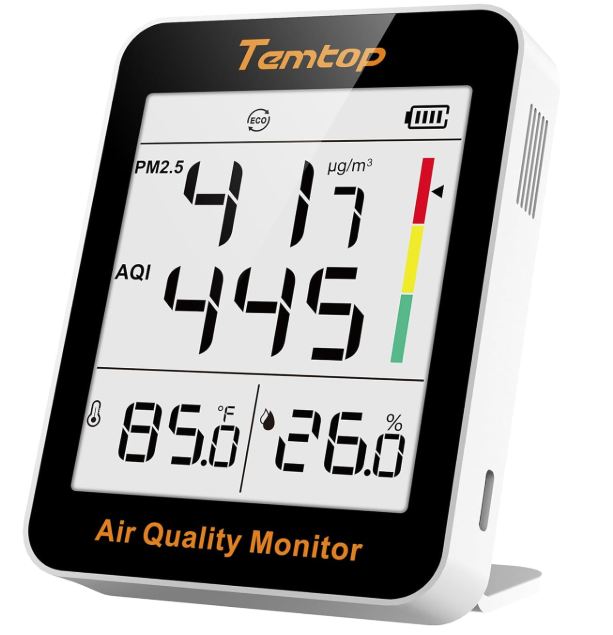
Temtop S1
Typical price: Check priceA focused, portable PM2.5 monitor. Walk into any room and know within seconds what you're breathing. Use it to test whether your purifier is working, compare rooms, or check outdoor vs indoor levels.
- ✓ Focused PM2.5 tracking with fast updates
- ✓ Portable — monitor anywhere instantly
- ✓ Clear colour LCD
- ✓ Affordable price
- ✗ No CO₂, PM10 or VOC sensors
- ✗ No app, connectivity or data logging
- ✗ Fewer capabilities than a premium smart monitor
⚠️Prices can change frequently on Amazon.
Want to catch this at the lowest price?
We log UK prices for the purifiers we recommend and email you when we record a meaningful drop — at least 5% or £10 off the last price we logged. No daily spam.
Comparison Table
| Product | Best For | Price | Rating | PM2.5 Accuracy | Additional Metrics |
|---|---|---|---|---|---|
| Airthings View Plus | Best Overall PM2.5 Monitor | Typical price: ~£250 | 4.8 | N/A | Whole home |
| Temtop S1 | Best Affordable Air Quality Monitor | Typical price: Check price | 4.5 | N/A | Single room |
Pros & Cons
Pros
- ✓ PM2.5 is the most health-relevant air quality metric you can track
- ✓ Reveals invisible pollution from cooking, candles, and traffic
- ✓ Real-time data empowers immediate action — open windows, run purifier
- ✓ Confirms whether your air purifier is actually reducing particles
- ✓ Affordable monitors available under £100
Cons
- ✗ Consumer sensors are less accurate than professional equipment
- ✗ PM2.5 doesn't tell you what type of particles are present
- ✗ Readings can be affected by humidity and temperature
- ✗ Data requires understanding to interpret usefully
Frequently Asked Questions
Conclusion
PM2.5 is the invisible health threat in every UK home — and cooking is a bigger source than most people realise. A monitor reveals what you can't see, turning air quality management from guesswork into data-driven action.
The Airthings View Plus provides the most comprehensive monitoring, while the Temtop S1 delivers focused PM2.5 tracking at a budget-friendly price. Pair either with a HEPA purifier for the complete clean-air solution.
Don't Forget Your Filters
Air purifiers only work if the filters are replaced regularly. Most people forget — and end up breathing dirty air.
Join the Filter Club