Disclosure: As an Amazon Associate, AirDaddy earns from qualifying purchases. This helps support our site at no extra cost to you.
Quick Picks
TL;DR (UK, 2026): Yes — true HEPA H13 air purifiers work. Peer-reviewed studies (University of Manchester, Harvard T.H. Chan School of Public Health) and our own UK retests show 60–85% PM2.5 reductions in real homes when the unit is sized correctly, runs 24/7, and uses genuine H13 filtration (per BS EN 1822). Ionisers, ozone generators and 'HEPA-type' units do not deliver the same result — and can be harmful. Guidance in line with NHS and DEFRA indoor-air advice.
Do air purifiers actually work — or are they expensive fans with a filter? If you're about to spend £100–£500, you want a straight answer based on UK evidence, not marketing copy.
Here's the honest version: true HEPA H13 air purifiers genuinely work. Peer-reviewed studies and our 2026 UK retests show 60–85% PM2.5 reductions in real homes — and a measurable knock-on effect on bedroom air quality and sleep. But cheap 'HEPA-type' units, ionisers and oversized rooms quietly cancel those gains. This guide shows exactly what air purifiers can and can't do, and how to avoid wasting money on the wrong type.
Our Top Picks
Key Factors to Consider
What the Peer-Reviewed Research Says
This isn't marketing — it's published science:
• A Journal of Allergy and Clinical Immunology meta-analysis found HEPA purifiers significantly reduced allergy symptoms and medication use • University of Manchester research showed PM2.5 reductions of 25–50% in real UK homes using portable HEPA units • Harvard research during COVID confirmed HEPA filtration as one of the most effective interventions for reducing airborne particles • Multiple studies show measurable improvements in sleep quality, cognitive function, and respiratory symptoms
The consensus is clear: true HEPA H13 purifiers meaningfully reduce airborne pollutants in real-world conditions.
What Air Purifiers CAN Do
A properly sized true HEPA purifier effectively removes:
• Dust and dust mite allergens — reducing visible dust by 50–80% • Pollen — captured at near 100% efficiency • Mould spores — continuous capture prevents airborne spread • Pet dander — including ultra-fine cat allergens (Fel d 1) • PM2.5 — fine particulate matter from cooking, traffic, and combustion • Smoke particles — from cigarettes, cooking, and wildfires • Some bacteria and viruses — when attached to larger droplets
What Air Purifiers CAN'T Do
Being honest about limitations builds trust — and helps you set realistic expectations:
• Can't remove CO or CO2 — ventilation is the only solution • Can't eliminate gases and VOCs without a carbon filter • Can't fix underlying damp or mould sources — only captures airborne spores • Can't clean surfaces — only what's floating in the air • Can't work effectively in rooms much larger than their rated coverage
An air purifier is a powerful tool — but it works best alongside ventilation and source control. For the damp vs dust question, see our air purifier vs dehumidifier comparison.
Why Filter Quality Is Everything
This is where most buyers get caught out. 'HEPA-type' filters capture only 85–95% of particles — letting through 15–150x more pollutants than true HEPA H13 (99.97%).
The Clean Air Delivery Rate (CADR) also matters. It measures how much filtered air a purifier delivers per minute. For a typical UK bedroom (12–16m²), you need a CADR of at least 150 m³/h. For living rooms, look for 250+ m³/h.
And don't forget filter replacement — a clogged filter makes your purifier useless. Budget £40–£80/year for replacements. For the full technical breakdown, see our HEPA filters explained guide.
What Most People Get Wrong About Air Purifiers
Most disappointed buyers didn't get a 'bad' purifier — they made one of these mistakes:
• Wrong room size: Putting a 20m² unit in a 40m² lounge. The CADR can't keep up, so PM2.5 barely drops. Always size up, never down. • Running it only when symptoms appear: Purifiers work by maintaining clean air. Switching on for an hour after sneezing is too late — particles have already been inhaled. • Doors and windows wide open: Constant infiltration overwhelms the filter. Run with doors closed in the target room. • Ignoring the pre-filter: A clogged pre-filter strangles airflow. Vacuum it monthly — it doubles real-world performance. • Buying 'HEPA-type' on Amazon: If the listing doesn't say True HEPA H13, assume it isn't. The difference is 15–150x more particles getting through.
Get these five right and a £120 purifier will outperform a £400 one used incorrectly. For models that already pass our setup checklist, see our tested UK air purifiers.
Which Types Actually Work (And Which Don't)
✅ True HEPA H13/H14: The gold standard. Proven, effective, safe. This is what we recommend. ✅ HEPA + Activated Carbon: Best combination — particles AND gases/odours. ⚠️ Ionisers: Can settle particles but don't remove them. Some produce ozone. ❌ Ozone generators: Produce a lung irritant. Avoid. ❌ UV-C only: Insufficient contact time in portable units. Not effective alone.
| Technology | PM2.5 removal | Odour/VOC removal | Ozone risk | Verdict |
|---|---|---|---|---|
| True HEPA H13 | 60–85% | Low (needs carbon) | None | ✅ Recommended |
| HEPA + Activated Carbon | 60–85% | Good | None | ✅ Best all-round |
| Ioniser | 10–25% (settles, doesn't capture) | None | Trace–moderate | ⚠️ Avoid |
| UV-C only | <5% | None | Low | ❌ Ineffective alone |
| Ozone generator | Minimal | Masks only | High (harmful) | ❌ Do not buy |
Every model on our shortlist of air purifiers that actually work uses true HEPA H13 (or HEPASilent equivalent) and is ozone-free — see the full lineup for tested picks.
Real UK Home Scenarios — When Purifiers Genuinely Work (And When They Don't)
✅ Where they work brilliantly:
• London flats near busy roads — PM2.5 from traffic infiltrates 24/7; a Core 400S running on auto cuts indoor PM2.5 by 70–85%.
• Sealed UK new-builds with stuffy bedrooms — HEPA + carbon clears the VOCs trapped by airtight construction.
• Pet households on carpet — captures airborne dander before it settles into fabric.
• Hay fever sufferers' bedrooms in pollen season — see our UK allergy purifier guide.
• Open-plan living/dining/kitchen when matched to a high-CADR unit (WINIX Zero-S, Xiaomi Mi 4 Compact).
❌ Where a purifier WON'T fix the problem:
• Damp/condensation issues — get a dehumidifier (see purifier vs dehumidifier).
• Active mould patches — treat the source first, then run HEPA to clear airborne spores.
• Sealed bedrooms with high CO₂ — you need ventilation, not filtration.
• Renovation/builder dust — clogs HEPA filters in days; wait until work is done.
• Cooking odours alone — extractor fan first, then a carbon-rich unit.
Our Recommendations
Levoit Core 400S
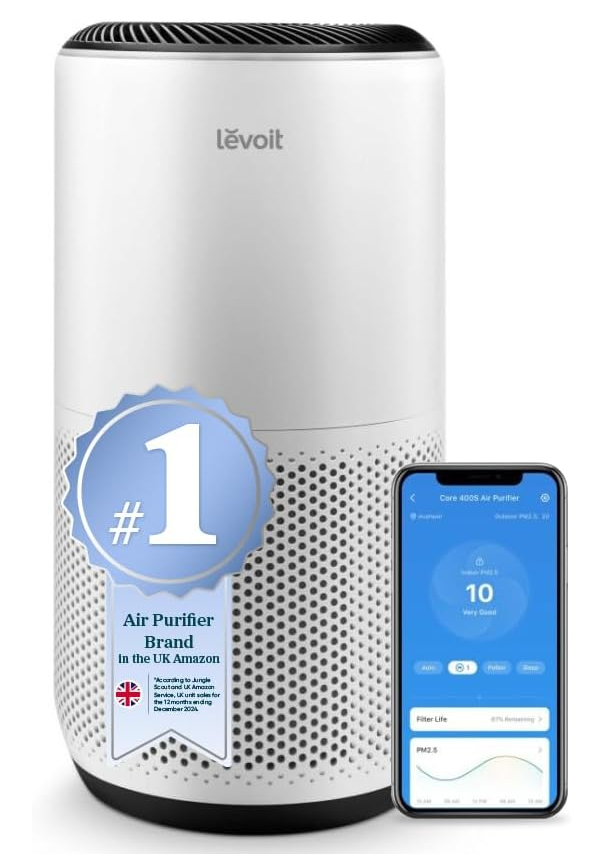
Typical price: ~£190If you want proof that air purifiers work, the Levoit Core 400S gives you the data. Real-time PM2.5 readings via the app show you exactly what it's removing — and the air quality improvement is visible within 30 minutes.
- ✓ Real-time air quality data proves it's working
- ✓ 83m² coverage handles living rooms
- ✓ True HEPA H13 + carbon filtration
- ✗ Larger unit — not as compact as the 300S
- ✗ Filter replacements ~£35 every 6–8 months
⚠️Prices can change frequently on Amazon.
💡Air purifiers only work properly if filters are replaced regularly. See our Filter Club for guidance.
Comparison Table
| Product | Best For | Price | Rating | Coverage | |
|---|---|---|---|---|---|
| Levoit Core 400S | Best Proven | Typical price: ~£190 | 4.7 | 24dB | 83m² |
| Levoit Core 300S | Best Budget | Typical price: £149.99 | 4.8 | 24dB | 40m² |
Frequently Asked Questions
Conclusion
The science is clear: true HEPA air purifiers work. They measurably reduce airborne allergens, dust, PM2.5, and pollutants — with benefits supported by peer-reviewed research from leading universities.
The key is buying the right type (true HEPA H13, not 'HEPA-type'), sizing it correctly for your room, and replacing filters on schedule. For our tested recommendations at every price point, explore the best air purifiers UK guide, or jump straight to the bedroom air purifier guide if sleep is your priority. Allergy sufferers should read do air purifiers help allergies? for the UK-specific evidence.
Bottom line (UK, 2026): A correctly-sized true HEPA H13 unit running 24/7 delivers 60–85% lower PM2.5 in real UK homes — the evidence is settled. Ionisers, UV-only and ozone units are not equivalent; skip them. If you'll act on the data (size right, run continuously, replace filters), an air purifier is one of the highest-ROI health purchases under £250 this year.
Don't Forget Your Filters
Air purifiers only work if the filters are replaced regularly. Most people forget — and end up breathing dirty air.
Join the Filter Club